
At Misty Mountains Jhaltola, time is usually a slow-moving river, dictated by the rustle of Oak leaves and the distant calls of mountain birds. But there is a specific window—a fleeting, almost religious 15 minutes—when time seems to hold its breath. It happens just as the sun prepares to dip below the jagged horizon of the Kumaon ridges. For a few precious moments, the massive snow-clad peaks of Trishul, Nanda Devi, and Maiktoli undergo a breathtaking transformation. They don't just reflect the light; they seem to "blush" from within, turning from a cold, sterile white to a warm, living rose-pink.
This phenomenon is scientifically known as the Alpenglow. To the casual observer, it is simply a beautiful sunset. To the seeker, it is a spiritual revelation. To the scientist, it is a rare masterclass in atmospheric optics and light scattering. In this deep dive, we explore the 15-minute magic that defines the evenings at Jhaltola and why this crimson transition is the ultimate luxury for the human soul.
The Advanced Physics of the Blush: What Exactly is Alpenglow?
To truly appreciate the Alpenglow at Jhaltola, one must understand that what you are seeing is not "direct" sunlight. If it were direct sunlight, the mountains would simply look yellow or orange. The "pink blush" is much more sophisticated.
Rayleigh Scattering and the Red Spectrum
As the sun reaches a very low angle, its light must travel through a significantly thicker portion of the Earth’s atmosphere to reach the high Himalayan peaks. During this long atmospheric journey, the shorter wavelengths of light (blue and violet) are scattered away by nitrogen and oxygen molecules. What remains are the longest wavelengths of the visible spectrum—the deep reds and pinks. This is the same reason why the sky looks blue during the day, but it is amplified a thousand times during the Alpenglow because of the massive "projection screen" provided by the Himalayan snow.
The Role of Atmospheric Refraction
The Earth's atmosphere acts like a giant lens. Even after the sun has technically dipped below your horizon at Jhaltola, the light is bent (refracted) around the curve of the Earth. This refracted light hits the high-altitude peaks of Trishul and Nanda Devi, which are thousands of feet higher than our ridge. This is why the peaks continue to glow even when the valley below has already plunged into the shadows of twilight. At Misty Mountains, because we are situated at 7,000 feet, the air is thin and incredibly clear, allowing this refracted light to hit the snow with surgical precision.
The Aerosol Effect: Why Jhaltola has the "Cleanest" Glow
Not all Alpenglows are created equal. In polluted regions or lower hill stations, the Alpenglow can look "muddy" or brownish. This is due to the presence of large dust particles and pollutants in the air.
The Purity of High-Altitude Air
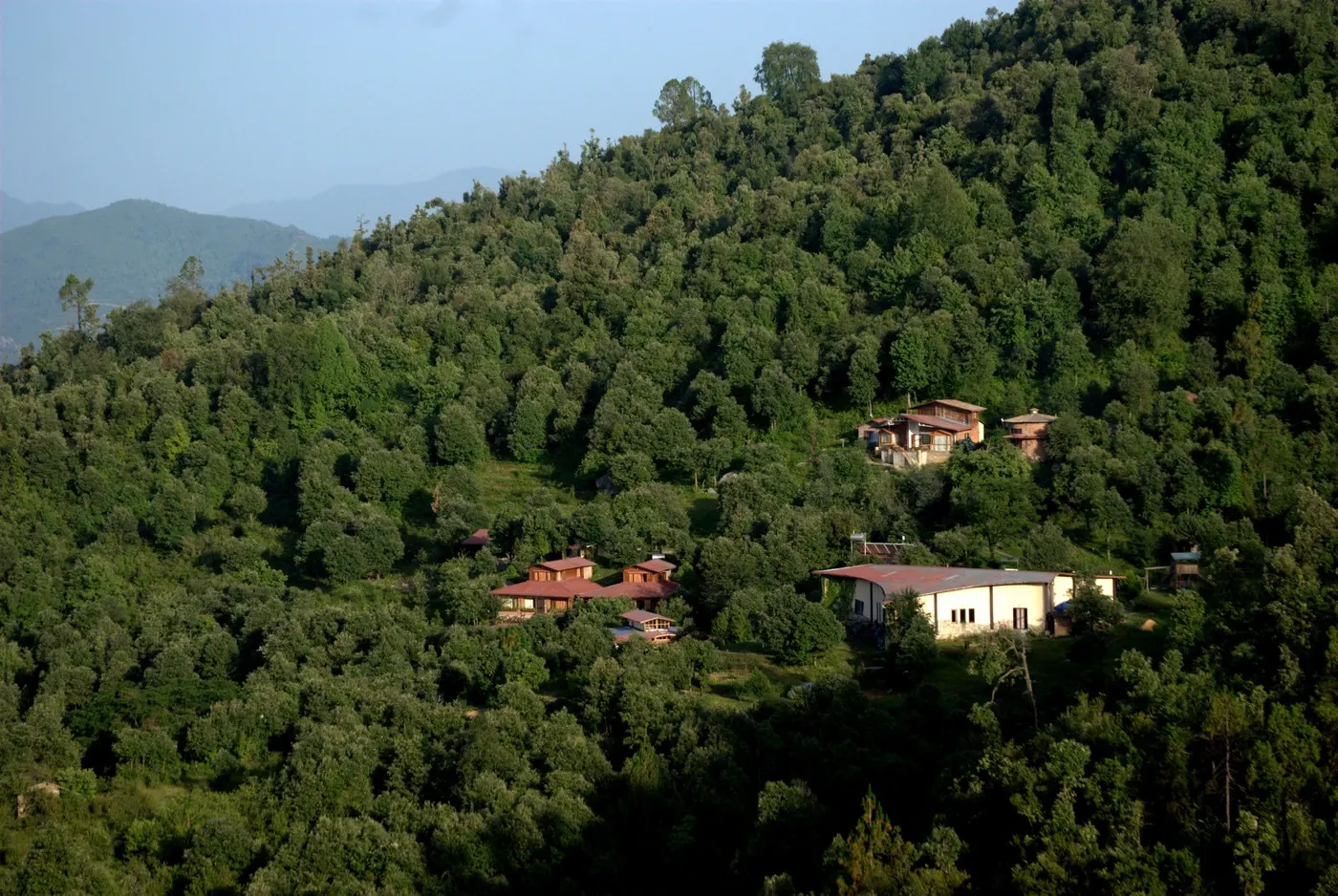
At Misty Mountains Jhaltola, we are surrounded by a 1,000-acre private forest buffer. There are no major cities or industrial zones for miles. This means the air is virtually free of "Aerosols" (tiny solid particles). When the air is pure, the light scattering is more "perfect." The pinks are more "rose," and the reds are more "crimson." Our guests often remark that the colors they see here don't look real—they look like they have been edited with a high-saturation filter. But this is simply nature in its most unfiltered, high-definition state.
The Vantage Point: Why Trishul and Nanda Devi are the Perfect Canvases
The Himalayas are vast, but the view from Jhaltola is geographically unique. We are perfectly aligned with some of the highest massifs in the world.
The Vertical Scale of Trishul
Trishul, standing at 7,120 meters, is shaped like a giant trident. Its western face is a massive, sheer wall of ice and snow. This verticality is key. Because the face is so steep, it catches the setting sun's rays at a near-perpendicular angle. This maximizes the intensity of the glow. When the Alpenglow hits the three "prongs" of Trishul, the light catches different ridges at slightly different micro-seconds, creating a 3D effect of light and shadow that you won't find at other viewpoints.
The 15-Minute Meditation: The Neurological Impact of "Awe"
Watching the Alpenglow isn't just a visual hobby; it is a neurological reset. In modern psychology, the feeling of "Awe" is being studied for its profound healing effects on the human brain.
Lowering the "Default Mode Network"
When you stand on our viewing deck, watching the peaks transition from gold to rose-pink, your brain’s "Default Mode Network" (the part responsible for self-referential thought and worrying about the future) shuts down. You experience a "Quiet Ego." The sheer scale of the mountains combined with the shifting colors forces your mind to stop its internal chatter. This 15-minute window provides a level of mental clarity that hours of forced meditation might not achieve. Guests at Jhaltola often report a sense of "Time Dilation," where those 15 minutes feel like an hour of profound peace.
Historical Records: The "Himalayan Gold" in Ancient Texts
The Alpenglow has been documented for centuries, long before modern tourism existed. In ancient Sanskrit texts, the Himalayas are often referred to as Himavat, and the glowing peaks were seen as the "Golden crown of the world."
The Traveler’s Chronicles
Early explorers in the 19th century wrote extensively about the "mysterious pink light" that appeared on the Kumaon peaks. They described it as a "celestial fire" that didn't burn. At Jhaltola, we feel like we are part of this long lineage of observers. When you watch the glow, you are seeing the same light that inspired sages and explorers five hundred years ago. It is a visual bridge across time.
Photography Masterclass: How to Capture the Magic of Jhaltola
Capturing the Alpenglow requires more than just a good camera; it requires an understanding of light.
The Exposure Dilemma
Camera sensors are often confused by the high contrast of the Alpenglow. If you expose for the dark forest around Jhaltola, the peaks will look like "blown-out" white blobs.
-
Underexpose Slightly: Always "Expose for the Highlights." Keep your exposure low so that the delicate pinks of the peaks are preserved.
-
The Golden Ratio of Timing: The "Peak Pink" usually lasts for only 120 to 180 seconds. Have your tripod set up at least 20 minutes before sunset.
-
Post-Processing Secret: Don't add saturation. Instead, play with the "Vibrance" and "Warmth" to bring out the natural tones that your eyes saw but the sensor might have missed.
The Biological Impact: How Our Eyes Perceive the Blush
There is a biological reason why the Alpenglow feels so "soft." It has to do with how the human eye perceives light during the transition from day to night—a phase called Purkinje Effect.
Rods and Cones in Transition
During the Alpenglow, our eyes are shifting from "Photopic" (daylight) vision to "Scotopic" (night) vision. During this transition, our sensitivity to red light decreases, but the intensity of the Alpenglow is so high that it "overwhelms" this shift. This creates a surreal, dream-like quality where the peaks seem to vibrate against the darkening sky. It is a biological hallucination of the most beautiful kind.
The Blue Hour: The Silent Sequel to the Alpenglow
As the 15 minutes of magic come to an end, the pink doesn't just fade into black. It enters the Blue Hour.
The Ghostly Indigo Transition
Once the last refracted ray of the sun leaves the peaks of Nanda Devi, the snow turns a deep, haunting, metallic blue. This is arguably as beautiful as the Alpenglow itself. The heat of the pink is replaced by the cold of the indigo. At Misty Mountains Jhaltola, this is the cue for our evening campfire. The transition from the "Visual Magic" of the peaks to the "Social Warmth" of the fire is a daily ritual that defines the Jhaltola lifestyle.
Why the Alpenglow is Exclusively Better at Jhaltola
What makes the Alpenglow experience at our property different from a regular hill station like Mussoorie or Nainital?
-
The Private Ridge Advantage: Most hill stations are crowded. At Jhaltola, you have a 360-degree unobstructed view. There are no electric wires, no buildings, and no billboards to break your line of sight.
-
The Forest Filter: The 1,000-acre Oak forest acts as a natural carbon sink, ensuring the air is exceptionally clear of the haze that often blurs the peaks in other parts of Uttarakhand.
-
The Soundscape: As we discussed in "The Symphony of Silence," the lack of noise pollution allows you to focus entirely on the visual transition. It is an immersive, multi-sensory experience.
Frequently Asked Questions (FAQs)
Q1: Does the Alpenglow happen every single day? A: No. It requires a specific atmospheric condition where the western horizon (where the sun is setting) is clear of heavy clouds, even if there are clouds over the mountains themselves.
Q2: Which month is the best for Alpenglow photography? A: October to March provides the crispest views because the winter air holds less moisture, making the light scattering more vibrant.
Q3: Can I see the Alpenglow from my room at Jhaltola? A: Yes! Most of our cottages are strategically oriented to face the Trishul and Nanda Devi range, allowing you to witness the "15-Minute Magic" from the comfort of your bed or balcony.
Conclusion: 15 Minutes to Last a Lifetime
The Himalayan Alpenglow is a reminder that the most beautiful things in life are often the most fleeting. You cannot hold the light, you cannot pause it, and you cannot buy it. You can only be present for it. At Misty Mountains Jhaltola, we don't just provide a room; we provide a front-row seat to the greatest light show on Earth.
When you leave Jhaltola, you might forget the food or the room decor, but you will never forget those 15 minutes when the mountains turned pink and your world stood still.