
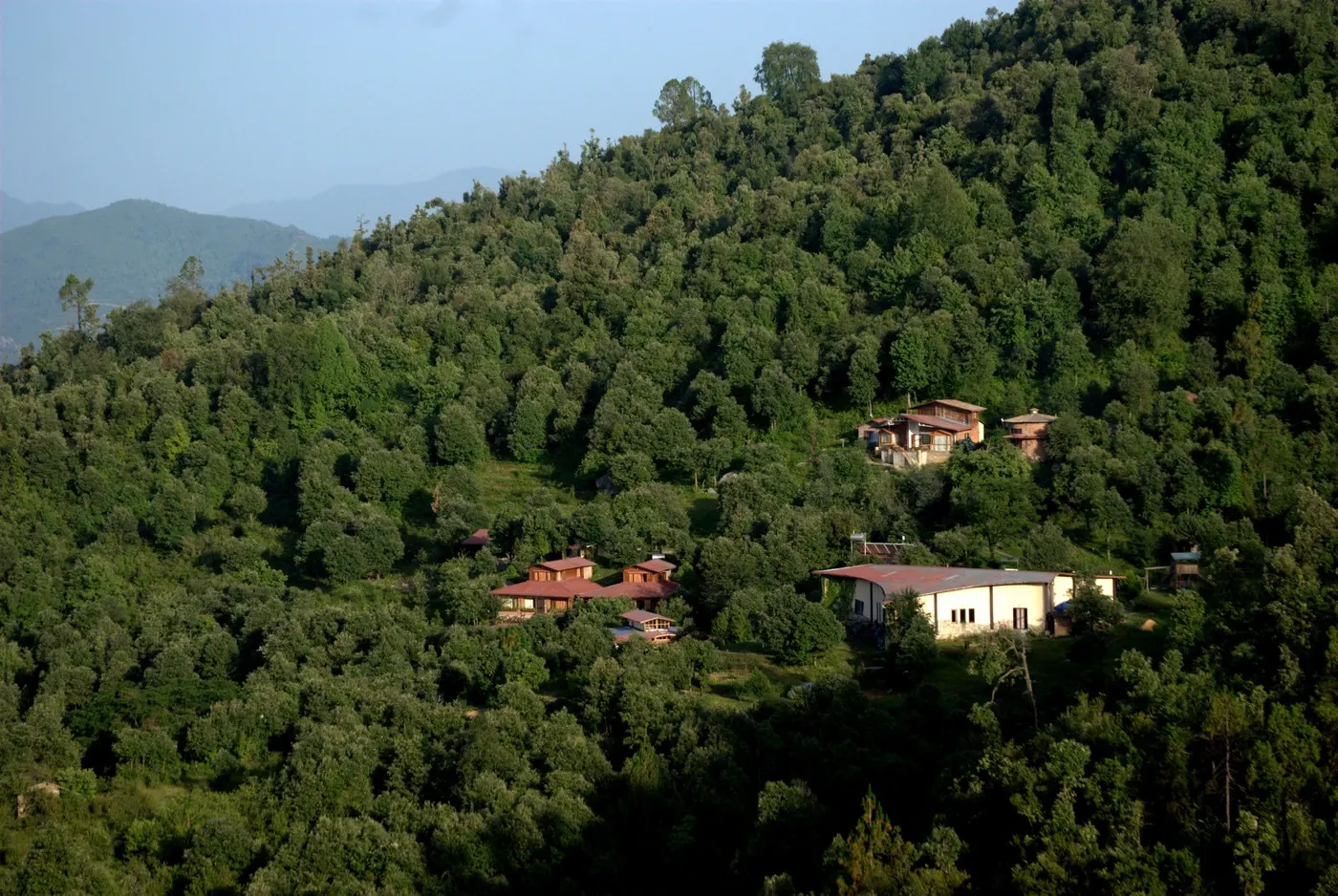
When the sun dips behind the jagged peaks of the Trishul and Nanda Devi, a transformation occurs at Misty Mountains Jhaltola. The 1,000-acre private estate, which vibrates with birdcall and golden light by day, begins to breathe in a different rhythm. For the urban traveler, the first thing they notice is the silence. But as the minutes pass and the ears adjust, you realize that the Himalayan night is far from quiet.
It is a Symphony of Silence—a complex, layered, and deeply ancient acoustic landscape. To stay at Jhaltola is to listen to the Earth in its most unfiltered state. This is a guide to decoding the midnight sounds of the Kumaon Himalayas and understanding why this "silence" is the ultimate luxury for the modern soul.
The Midnight Soundscape: An Overview
| Time Bracket | The Dominant Sound | The Source |
| Twilight (6:30 PM - 8:00 PM) | The Great Chorus | Cicadas, Crickets, and Dusk Birds |
| Midnight (11:00 PM - 2:00 AM) | The Deep Pulse | Wind in the Oaks, Scops Owl, Flying Squirrels |
| Pre-Dawn (3:30 AM - 5:00 AM) | The Apex Stir | The Leopard's 'Saw', Barking Deer, Distant Streams |
The Physics of Sound in High Altitudes: Why Jhaltola Sounds Different
Have you ever wondered why a distant bell or a bird call sounds so much "sharper" in the mountains compared to the plains? There is a fascinating scientific reason behind this.
Air Density and Sound Clarity
Jhaltola sits at an altitude of approximately 7,000 feet. At this height, the air is thinner and significantly cleaner. In the plains, sound waves have to fight through heavy humidity, dust particles, and urban smog, which "muffles" the sound.
In the crisp air of our estate, sound waves travel with much less resistance. This is why the midnight sounds feel so "high-definition." When an owl hoots across the valley, you aren't just hearing a noise; you are hearing the texture of the sound. The thin air preserves the higher frequencies, allowing you to experience the full spectrum of the forest’s orchestra.
The Night Shift: Botanical Breathing and the Sound of Oxygen
While we perceive the forest as a static entity at night, it is actually a busy factory. The transition from photosynthesis to respiration creates a subtle change in the forest's "ambience."
The Transpiration Hum
In the dense Oak forest of Jhaltola, millions of trees are releasing moisture. On a completely still night, some experts and sensitive listeners claim to hear a "hiss" or a "soft sigh." This is the sound of the forest breathing. Because Jhaltola is a High-Density Forest Buffer, this collective respiration creates a micro-climate that affects how sound travels. The slight increase in humidity at the canopy level helps reflect sound back to the ground, acting like a natural amphitheater.
The Unspoken Music of Weather: The Sound of Mist and Snow
One of the most elusive sounds in the Kumaon Himalayas is the sound of weather changes during the night. Most people think mist and snow are silent, but at Misty Mountains, we know better.
The "Hiss" of the Mist
When the midnight mist rolls up from the Ramganga valley and enters the Oak forest of Jhaltola, it carries a very subtle, high-frequency "hiss." This is the sound of millions of micro-droplets of water colliding with the dry leaves of the Oak trees. It signals a shift in temperature and humidity—a warning to the forest creatures that the "White Veil" has arrived.
The Weight of Snow
If you are visiting during the winter, listen for the "Creak." As snow accumulates on the sturdy branches of the Himalayan Cedar (Deodar) and Oak, the wood begins to settle under the weight. This rhythmic creaking, interspersed with the soft thud of snow falling from a branch to the forest floor, creates a nocturnal lullaby that is unique to the high-altitude winters.
Indigenous Folklore: What the Locals Hear in the Night
The Kumaoni people have lived in harmony with these sounds for thousands of years. Their folklore is a manual for decoding the midnight symphony.
Legends of the 'Van-Devatas'
Local elders often talk about sounds that cannot be explained. A sudden rustle in a windless grove or a rhythmic tapping on a tree trunk is often attributed to the Van-Devatas (Forest Deities). At Misty Mountains, we respect these cultural narratives. They remind us that we are guests in a landscape that has its own ancient rules and inhabitants. Understanding these stories adds a layer of spiritual depth to your auditory experience.
The Science of Auditory Pareidolia: Why We "Hear" Voices in the Wind
In the absolute silence of Jhaltola, something strange happens to the human brain. This is called Auditory Pareidolia.
The Brain's Search for Meaning
When your brain is deprived of the usual urban noise, it begins to search for patterns in the "Natural Quiet." You might think you hear a distant conversation or music in the sound of the wind moving through the pines. This isn't a hallucination; it is your brain trying to make sense of the complex harmonics of the forest. Understanding this phenomenon allows you to relax into the silence, knowing that the "voices" you hear are just the mountain singing to you.
The Predator’s Breath: Understanding the 'Saw' of the Leopard
For many, the ultimate mystery of the Himalayan night is the Leopard. While they are masters of stealth, they are not always silent.
The Sawing Sound
If you are lucky, you might hear a sound that resembles someone sawing through a thick piece of wood. This is the territorial call of the Indian Leopard. It is a rough, rasping sound that carries for miles across the Jhaltola valleys.
The Alarm Calls
More often, you will hear the leopard's presence through others. The Barking Deer (Kakar) has a loud, harsh bark. When a leopard is on the move near the estate, the deer will sound an alarm that echoes through the midnight air. This is the "Social Media" of the forest—information being passed from one species to another in real-time.
The "Jhula" Lichen: The Forest’s Natural Sound-Dampener
The 1,000-acre estate is draped in Usnea (Old Man's Beard) lichen. Beyond being an indicator of 100% air purity, these lichens serve a secret acoustic purpose.
The Acoustic Padding of Jhaltola
The dense moss and hanging lichens act as natural acoustic foam. They absorb high-frequency sounds, making the forest interior feel "padded" and soft. This is why a walk into the deep forest buffer at midnight feels so intimate. The echoes are gone; the sound is close and incredibly crisp.
Psychological Restoration: The Power of 40 Decibels
Urban environments usually sit at 70-80 decibels. At Misty Mountains Jhaltola, the midnight level drops to a consistent 30-40 decibels.
Healing the Nervous System
This drop in decibels is a signal to your nervous system to switch from "Sympathetic" (Fight or Flight) to "Parasympathetic" (Rest and Digest). This is why guests often report the "Best Sleep of their Lives" at our property. The midnight symphony isn't just a soundscape; it is a neurological reset button.
Acoustic Architecture: How Our Cottages Enhance the Symphony
At Misty Mountains, we haven't just built rooms; we have built observation decks for the ears.
Wood and Stone Harmonics
The use of local stone and high-quality timber in our construction isn't just for aesthetics. These natural materials have specific acoustic properties. Wood, in particular, resonates with lower frequencies, making the sounds of the distant river or the wind feel "warmer" and more grounded. Sitting on your private deck, the architecture itself becomes a musical instrument, filtering the raw sounds of the Kumaon wilderness into a soothing melody.
The Visual Silence: How the Midnight Sky Complements the Sound
One cannot talk about the midnight sounds without mentioning the Visual Silence of the Jhaltola sky. When the sun goes down, the light pollution vanishes, leaving a canopy of stars that is so bright it feels "loud."
The Silence of the Milky Way
Watching the Milky Way move silently over the ridge provides a visual counterpoint to the sounds you are hearing. The vastness of the space above you makes the small sounds of the forest floor feel even more precious. It is a dual sensory experience—the infinite silence of the cosmos meeting the intimate symphony of the Himalayan forest.
Frequently Asked Questions (FAQs)
Q1: Will the sounds keep me awake at night?
A: Most guests find the rhythmic sounds of the forest floor and the distant river far more soothing than any white-noise machine.
Q2: Can I go for a night walk to hear these sounds?
A: We offer guided "Night Nature Walks" with our naturalists. We don't recommend solo night walks into the deep forest buffer for safety.
Q3: Are there sounds I should be worried about?
A: Every sound in the forest has a biological purpose. Our team is always available to explain any sound that might feel unfamiliar to you.
Conclusion: Returning to the Source
The Symphony of Silence at Jhaltola is a reminder that we are part of a larger, living system. In the city, we are the center of the universe. In the Himalayan night, we are just one of many listeners. When you leave Misty Mountains, the sound you will miss the most isn't the music—it is that profound, velvet silence of a midnight in Kumaon. It is the sound of your own heart beating in sync with the mountain.